2009年9月27日 星期日

Studying Chinese Language and learning the culture -- studying the culture to learn the language


Studying a foreign language is a gateway into a new culture. Thoughts and ideas are expressed, and phrases are structured to directly reflect the culture. Learning the language is the gateway to understanding the people.

Chinese, however, requires more than just the study of the language. Often times proverbs consisting of only 4 or 8 characters (words) entail a great deal of meaning. They are the profound morals of ancient tales. If you were just to hear or read the proverb without knowing the story, you'd be missing meaning. To understand the language and be fluent, you have to study the culture. Now the language is insufficient for communication and studying the culture becomes equally important.

For example if I were to translate one proverb I just studied: Towards oneself spear shield. 自相矛盾。 The meaning is that someone is being a hypocrite or is contradicting themselves. The story behind this phrase is that a salesman was boasting about his spears and shields. He said there's no shield in the world that his spears couldn't penetrate. Naturally his shields were also the strongest in the world and he boasted there were no spears able to penetrate them. When asked what would happen if one of his spears were used against one of his shields, the man had no answer. A foolish and blatant hypocrite, the moral and meaning of the story is summed up in those four character above, literally: self, towards, spear, shield.

This is a relatively simple example of the entanglement of culture and language. Often times only the first 4 characters of an 8 character proverb are written somewhere. If you know the proverb and the culture behind it, this is all you need to grasp the meaning. Take someone like me, however, who is proud to recognize these characters but can't decipher the meaning: People before earlier come. Well it ends up meaning, after you know the rest of the proverb and the culture behind it: "Greater than all who have come before him."

Now Chinese love to quote and reference these proverbs. They've been learning them for years and it's totally common for them to bring them up when talking about business. So if you truly want to master the Chinese language and communicate without hindrance... studying Chinese culture and history is a requirement. As if studying the language itself wasn't a daunting task, now we've all got more work to do. The good news is that the study is quite rewarding.

2009年9月7日 星期一

New Shaolin form

Today it has been 9 full weeks of learning Shaolin Kung Fu in the park. I've just now begun to learn a new form. My teacher says I'll learn it quickly: in three days. I spent over two months on the last form and now I'll begin learning a second one. This is fitting. I believe there will also be a performance on the 26th of this month. Look for a relevant update around that time.

2009年9月6日 星期日

Ghost Month in Taiwan: A silly superstition -- a sensible faith


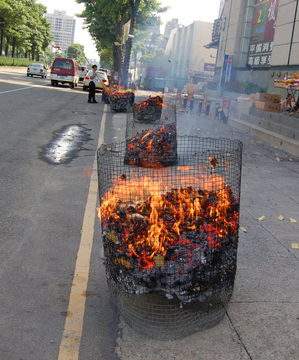
Early last month I was surprised on a morning run. I had retreated, from running against traffic on the road, to the sidewalk. I expected a haven. I found a woman burning what I thought to be garbage outside of her front door and in the middle of the sidewalk. I was frightfully forced back to the road where I decided the oncoming traffic was less of a threat than random sidewalk fires. On later runs I noticed people setting up tents in the streets. They put tables out and filled them with food. I paid little attention to them, assuming that this must be a season of graduations and weddings and the tents were for hosting celebrations.

My coworker was later advised not to buy a new scooter as it was Ghost Month. Ghost Month is a time when the deceased ancestors of the past are released and run through the world of the living. It is a time for the living to pay respect to those who have come before and ease their suffering. The woman I saw outside burning had been burning ghost money on the street as an offering and I would later see many more people doing this. The tents were not for family celebrations: they were offerings to the ghosts. These offerings included a lot of Chinese foods, but also Coca Cola, Heineken and many other fairly common things we eat all the time.

If you are thinking the same thing I was when I learned about these offerings then you are no doubt wondering: “So what happens to the food?” I asked my friend exactly this. The ghosts don’t eat it… so how long is it left there? After a couple hours the living will then eat the food, but that’s not the point. The food serves as an offering for the ghosts and so later eating it yourself can bring good luck. My initial impression of Ghost Month: utterly superstitious. But this holiday is celebrated widely across Taiwan and China, so are all Chinese really superstitious?

Our first impressions need always be reconsidered from a different perspective. I imagined the life of a traditional Chinese raised here and then moved to the US to see the holidays I experienced growing up Catholic.

The first thing that came to mind was the weekly receiving of the sacrament. Imagine explaining how, after undergoing a service and prayer it is time to drink the blood and eat the body of your savior? Your savior died almost 2000 years ago. Of course even non-Christian Americans are familiar with the meaning behind the body and blood of Christ and its well know that it is a symbol. But taken out of context it seems as if we are cannibals that believe eating our savior will lead us to salvation: a glorious life after death. It would be foolish not to ask: “Are you some cult of want-to-be vampires?” (This is not meant as an insult to the Catholic faith; I’m demonstrating the profound meaning surrounding relativity)

Now contrast the existence of ghosts with the existence of an omnipotent god. Americans are primarily monotheistic. It is commonplace among Western faiths to think of only one god and anything else is old fashioned. In general this god’s beginning coincides with the beginning of time itself – his origin is unexplainable. Conversely the gods that are worshipped, or the ghosts here in Asia have a distinct origin. They are the spirits of our ancestors. They came before us and have an easily defined, dare I say, easier to believe origin.

My first impression was that these ghost-fearing Chinese are silly and superstitious. After a bit of thought I realized these superstitions are less surprising then those I’ve grown desensitized in the West. Ghost Month is not superstitious in the least, it is religious. I am not of this faith, yet it seems more logical than my own estranged faith.

---These are just the opinions of an Engineer working abroad as a foreign teacher. Don’t be offended but I invite you to offer me any criticism; be it constructive or otherwise.

2009年8月26日 星期三

2 months -- Foreigners in Taiwan

I've now been in Taiwan for two months. It's been great and I've been treated very well. I've learned a lot and my Chinese has certainly improved, although I'm still quite the novice.

Although I may have experienced a slight racist experience today, I want everyone to know that I have been treated well here: in many ways better than I deserve.

My coworker and I went out to lunch at a local steak house. This is a nice looking place, although it is affordable (for steak, keeping in mind that there are no cows in Taiwan). It had just opened about a month ago. My coworker and I were led around by the hostess, she first brought us to the left and, despite seeing an open table quickly turned around and led us to a larger table in the back. We were the only ones there.

Later a large group came in and sat next to us... but got up before settling and presumed to change their seat. I was baffled: did they just request not to be seated next to the foreigners? Was there another explanation? I wondered and conversed with my colleague. Later, an older man and his wife sat, briefly on the other side of the room and then had the same reaction. No way! I must have been a coincidence or something we were overlooking. But the feeling was that we had been stuck in the back of this restaurant and no one wanted to sit next to us.

As a white male I've been exposed to very few racist comments. A black girl called me "White boy," with a snear once or twice. I distinctly recall hearing this once with her friends reply saying, "Leave him alone." Regardless, any kind of racism can really make your blood boil. Just thinking that we may have been segregated to the back room and that people didn't want to sit next to us... the idea infuriated me. Of course my ignorance of the situation was more than enough to calm me down, but...

Let me remind you, we were in a steak house. We ordered NEW YORK STYLE STEAKS! I am a New Yorker!

I encourage everyone to rid their lives of racist actions, to the best of your abilities and within reason. I also thought the steak was okay, at best. If you plan on traveling to Taiwan, get your fill of steaks before your trip.

2009年8月19日 星期三

Taiwan Vs China

There are many differences between Taiwan and China. There are also a lot of interesting similarities. Whatever your opinion on Taiwan's independence is, you cannot argue that Taiwan is a Chinese place. I've heard mainland Chinese people say that Taiwanese were more traditionally Chinese than those in the mainland. I've also heard from a rather educated tourist, that people in the mainland will see a foreigner and try to put up a front... basically they want you to think they are very traditional. Likewise the people in Taiwan had no need to put up a front, they simply lived and breathed traditionally.

This is interesting because Taiwan is more modernized, and has developed faster than China.

But the difference I want to focus on is one my friend often received in her emails. She is Taiwanese and would often receive chain letters comparing Taiwan and China. They always depicted China as a crazy backwards country that new no manners. For example, pictures of kids peeing on a tree in the newly built Disney Land. Or photos of the most disgusting toilets you could ever imagine, with captions like, "Do you really want to go to the bathroom in mainland China?"

Today, as I was walking home from a main street I passed by a toy shop for children. I heard a woman's voice behind a car parked right in front of the shop. She muttered something and then... "right here" (I'm translating of course). I looked over and in plain sight I saw her son with his pants down around his but as he was aiming his pistol. What the hell!? This was two feet from the stores front door and on the side of the road. They didn't even take the couple steps to get all the way behind the car. I was tempted to take out my camera and take a shot right there, but, well, that would have been hard to explain.

In any event, I'm a bit critic of how childish and absurd politics and national judgements are made these days. Think twice before you make a racist or nationalistic statement looking down on another place; and take a better look at the people around you first. This is a valuable lesson for everyone, not just Taiwan.

All things aside, Taiwan may not be the most sophisticated place, especially since I'm living out of a major city, but it is still a great place to live. The people here have all been great.

2009年8月13日 星期四

功夫 -- update

I try to keep this blog more meaningful than a simple list of updates on my life... but there may be some people interested in my Kung Fu training and if not, well I'd love to talk about it anyway.

I've continued to practice Kung Fu on weekday mornings before class. I finished learning the general movements of the first form some time ago, maybe 3 weeks ago by now, but I've only been working on that thus far. I have no complaints whatsoever: I'm being taught really well about the movements and their meanings. I also get two points of view to learn from: my teacher who teaches me a more traditional style, and his grandson who practices a more elegant and modern style. I'm thinking the difference is primarily that the older style is more focused on actual use and the modern style is more focused on competition. Either way it has been great to learn so far. Here is a video clip of Huang Po Sheng practicing the entire form in a performance:


Too bad this video isn't better quality. Po Sheng actually gave me a few vidoes from differnet performances. Here he is doing a different form:


This was the form that they originally started teaching me. After one day Huang Grandfather said this was for children and that Po Sheng would finish teaching it to me, but that he would teach me the above form. Keep in mind my Chinese is still limitted so the message your getting from me is a weakly translated one.

Here is one more video of some guy I don't even know, but he looks good throwing down this open hand form:


I don't know if I'll learn any weapons myself, although they did mention it. As for now, I prefer just to learn the open hand forms, but if anything develops I'll post it. Of course I'll post a video of me doing the form once I have learned it well enough, and then can find someone to video tape.

2009年8月10日 星期一

Typhoon Morakot hits Taiwan

The end of last week was full of rainy days as Typhoon Morakot approached the island of Taiwan. A typhoon is basically nothing more than a hurricane, just located on the Eastern Hemisphere... same thing, different location and therefore a different name. Morakot ended up hitting the island on Thursday night and schools were shut down all across the island, for both Friday and Saturday. Now the storm, as I experienced it, in Taichung (on the western side of the island and near the middle in terms of latitude) was not impressive at all. There has been a lot of rain and there were some strong winds on Friday. However, this is nothing out of the ordinary, we didn't lose power and while I stayed inside all day, there were some people out and about, not many, but a few.

It was a serious storm, but nothing I haven't seen before from living in New York or Boston. Based on the wind speed, it would have been classified as a level 1 hurricane back home. Nothing to shake a finger at, but nothing to get too worked up about either... not in Taichung any way.

The Typhoon was actually quite devastating. It was larger than the entire island of Taiwan and came from the South East -- heading North West. The East side of Taiwan was devastated as well as some places in the South. Since the center of Taiwan is so mountainous, that provided a great deal of protection for the East and the location I am in as well. With that said, most of the damage was due to flooding from intense rains. In one particular case some flooding rose up from a low level drainage path... and then eroded away the foundation of a building on one side. The building ended up collapsing on it's side.

The flooding was really serious in many places and caused a great deal of trouble. Some people did die, too. If you're interested in reading more about the typhoon just do a google search for Typhoon Morakot and you'll be sure to get the updates. Photos are available through the following link:

http://tw.news.yahoo.com/photostory/morakot.html?p=63